AdobeStock_506766186

European insights: lifelong learning and migration in TVET – five big challenges and real world solutions

Manuel Souto-Otero, 2025

Background

Across Europe, around 94 million voluntary migrants take part in lifelong learning, yet their participation is only about half that of nationals, even as employers warn of growing shortages in mid-level technical skills. The author identifies five interwoven barriers behind the gap: situational constraints of civic integration; fragmented information on pathways and rights; restricted entitlements to funding and recognition; conscious or unconscious discrimination in competitive TVET tracks; and absence of flexible, culturally sensitive provision.

Drawing on 2024 Eurostat data and country case studies, the scoping studies matches each barrier with real-world solutions that are already being tested. These include one-stop guidance portals, automatic recognition of previous learning, multilingual programmes, equal funding rules, and pre-apprenticeship schemes. It argues that scaling these measures into coherent, migrant-friendly lifelong-learning systems is both an economic necessity for ageing societies and a test of Europe's commitment to equality, social cohesion and shared prosperity.

About 74% of the UNESCO member states reported efforts to expand learning beyond the traditional classroom, making it accessible across all stages of life. By incorporating work-based learning and continuing professional development, TVET systems are becoming more adaptable to the changing job market (UNESCO, 2024).

Why lifelong learning matters

Lifelong learning is associated with multiple positive outcomes at the individual level. The emphasis is often placed on employability, but lifelong learning has positive effects on other areas too - such as civic attitudes, social connectedness, self-esteem and health. Lifelong learning thus provides us with the resources to function as workers, but also as citizens and as individuals, and to live more fulfilling lives. Lifelong learning is particularly important for TVET given the current pace of technological and social change. This makes continuous skills updating essential for TVET graduates, both in terms of maintaining and developing their employability and to fulfil their roles as active and connected citizens.

Lifelong learning enables individuals to adapt, and cope with change. While the world is changing fast for everyone, migration experiences further accelerate change. While those experiences can be vastly different, when individuals move to a new country, they often face a new social context, new ways of doing things at work, and of relating with those institutions, both private and public, that support us in our lives. But it is not only the context that changes. The positioning of the individual in that context can also change significantly. They may take-on a new job, similar or different to the job they had in their home country, and they may experience limitations in their rights and entitlements and not be allowed to exercise the profession that they were practicing in their home country. Their social networks and their ways of relating to others change. They often face linguistic barriers in expressing themselves and question their identity. But this is why migration can be an enriching experience: because it creates new gaps in knowledge that need to be filled, and pushes us to learning new things. It makes us think about differences between our home and host contexts, and evaluate those differences. It makes us reflect on our position in the world and question long- held beliefs and behaviours, adapt to new situations and reinvent ourselves. Thus, if lifelong learning is beneficial for all, it is crucial for migrants.

Challenges that migrants face in accessing lifelong learning

Europe is a highly developed part of the world, with strong economies and institutions, which make it a highly desirable place to live. The top five countries in the world, and eight of the top 10, on the Human Development Index (UNDP, 2025:2278) are European. Although it is not the world's most populous region, Europe hosts more international migrants than any other region in the world, over 94 million in 2024 (DESA, 2025), almost double than in 19901. This means that almost one in three international migrants in the world are in Europe. In 2024 international migrants made up almost 13% of the European population. This is around 3.5 times higher than the share of migrants in the world as a whole2. These figures include all types of international migrants, but international migrants can be in very different situations. They include voluntary migrants as well as forced migrants, such as asylum seekers and refugees. This contribution focuses on the situation of voluntary migrants &ndash referred as "migrants" below.

Overall, migrants in Europe tend to be younger than nationals (Eurostat, 2024), less educated and are less often in employment, although there is significant variation depending on migrants' country of origin (Eurostat, 2025). Their unfavourable labour market integration and higher risk of social exclusion, combined with the needs that Europe has given its ageing population and labour shortages in various sectors and occupations (Pouliakas and Souto-Otero, 2022), indicate the benefits of ensuring access to lifelong learning for migrants. The experience of European countries like the Netherlands shows that TVET can be particularly responsive to the integration of migrants (Wedekind et al., 2019). However, and paradoxically given these needs and benefits, migrants can face important barriers to access lifelong learning, and show lower rates of participation in lifelong learning than nationals (Eurostat, 2025).

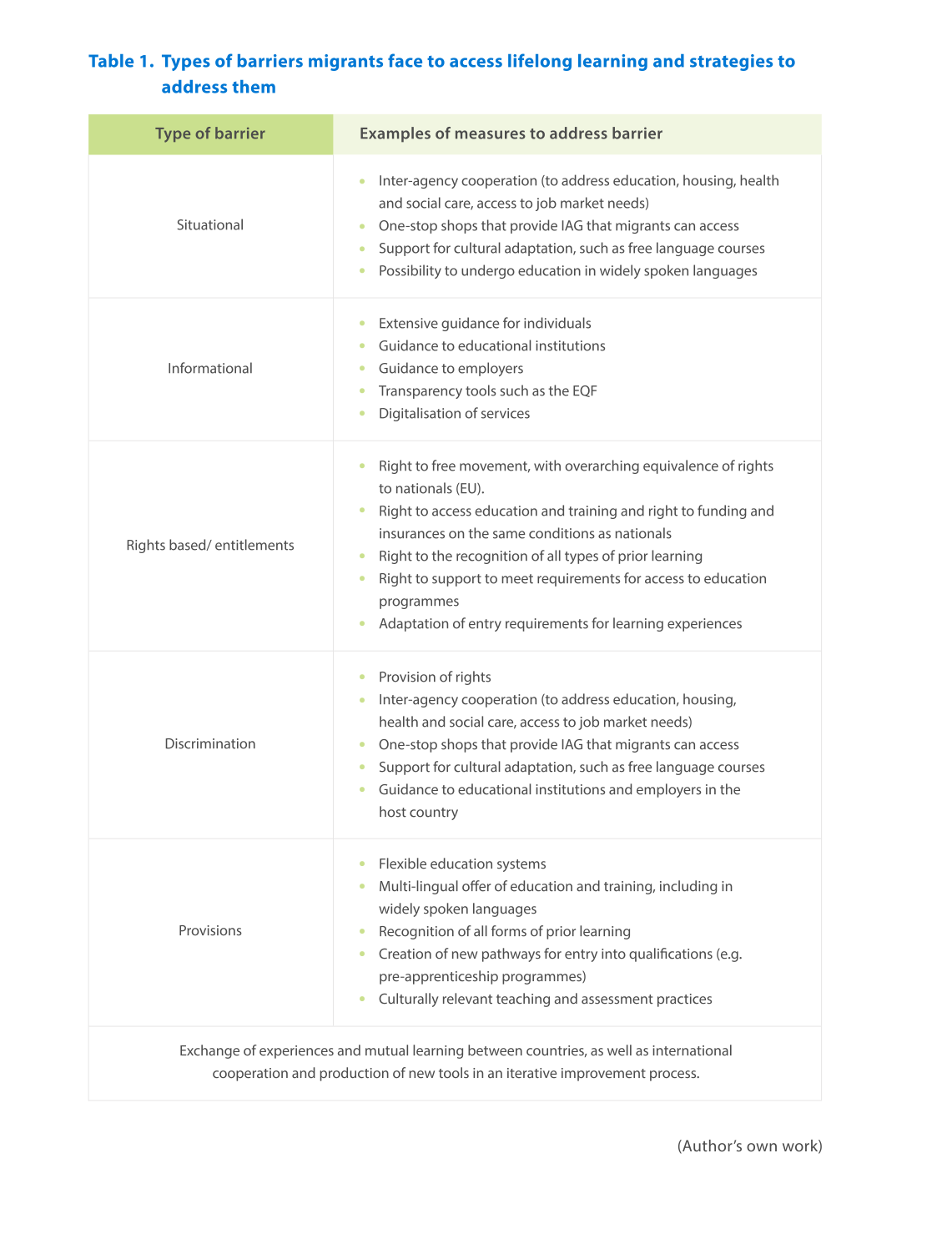
Indeed, while Europe is a highly diverse region with a long history of migration, which provides strong guarantees and social rights to those living within its borders, migrants still face various challenges in accessing lifelong learning. We can identify five main sets of challenges related to: situation, information, entitlements or rights-based challenges, discrimination and provision. Many of the challenges that migrants face in Europe are also common in other regions of the world, and some of these challenges are also faced by nationals. The discussion focuses on access as participation but has implications for barriers to meaningfully experience and benefit from a programme (see also Souto-Otero and Whitworth, 2006), what we can call access to programmes, access to meaningful learning experiences, and access to qualifications.

A first set of major challenges that migrants face in accessing lifelong learning are situational. There are multiple prerequisites to access lifelong learning, which are often taken for granted but can delay access for migrants, as they find their way in their host country. These are not necessarily related to education and skills. Central prerequisites include accommodation, health (including mental health), economic resources to cover course fees - if they exist - and living costs, cultural resources - particularly the linguistic competences required to benefit from learning experiences in the host country (Söhn, 2020) but also high aspirations (Yakushko et al., 2008) - and time to learn.

Lack of information is another important barrier. Navigating education and training systems is far from an intuitive action. We progressively get to know the education system in our countries as we grow up through experience, and through the experiences and insights of others we know. Many migrants do not have the opportunity to benefit from such sources of information in their host country. This lack of orientation on what is available, how to access it or how it is valued in society and the labour market is a barrier to lifelong learning. Migrants can also face complex administrative requirements to access lifelong learning or receive financial support for it, which can act as deterrents to participation. Lack of information also disadvantages migrants in the other direction: lack of knowledge, by educational institutions and employers in the host country, about the value of migrants' experiences in their home countries, which can be detrimental to their participation in further learning. Many guidance professionals themselves report to be unprepared to provide advice to recently arrived migrants and culturally diverse target groups (Sultana, 2022).

Lack of rights and entitlements, such as the right to access education or financial support to undergo education, can hamper migrants' access to lifelong learning. Rights and entitlements are closely related to some of the barriers discussed above. For example, lack of economic resources to cover the costs of a learning experience can be mitigated through an entitlement to a loan or grant. Access to education and training programmes often has some prerequisites, and a lack of clear, effective and flexible systems for the recognition of migrants' previous learning experiences can be an obstacle. UNESCO (2012:8) defines "recognition" as the process of granting official status to learning outcomes and/ or competences, which can lead to the acknowledgement of their value in society (see also Cedefop & European Commission, 2024). Even when systems for recognition are in place they may result in an unfair 'devaluation' of the skills that migrants bring with them and of the rights they provide in their home country, for example in terms of access to higher levels of education and training (Souto-Otero and Villalba-Garcia, 2015). Access to certain TVET programmes, such as apprenticeships, can present additional challenges, given labour market regulation requirements on right to work that not all migrants may automatically meet.

The exercise of formal rights can be threatened by discrimination, which can be conscious or unconscious. In countries where TVET tracks are highly competitive, for example some apprenticeship tracks, migrants may face discrimination at the time of selection by companies (Imdorf, 2017), even if they have a formal right to be considered for selection on equal terms to other candidates. Some employers and training institutions may discriminate against migrants because of their foreign nationality, and others because of characteristics assumed to be linked to specific nationalities - such as religion - or because often they are older learners. Other times migrants can be discriminated against because they have non-standard backgrounds that educational institutions and employers in the host country do not understand. Discrimination can thus make it difficult to access suitable training at the right level for migrants, even when options are in theory open, and discourage them from applying for lifelong learning opportunities in the anticipation of unfair treatment.

Finally, lack of suitable provision refers to the absence of learning experiences to access, in the host area, that the migrant person would find suitable. This may be because there is a mismatch between the organisation of the education system in the home and host country, making the career trajectory of the migrant a dead-end, but can also take more subtle forms, such as the use of forms of pedagogy or assessment that are not conducive to satisfactory performance for those who are not nationals. These are factors that can act as a barrier, deterring migrants from engaging in lifelong learning in the host country.

1. Own calculations from IOM 2024 and DESA 2025. The figures include all types of international migrants (any person who changes his or her country of usual residence) -see DESA (1998) for further details.
2. Own calculations from DESA 2025.

Policy frameworks and strategies

Equality and inclusion are core European values, enshrined in the EU Treaties (Muir, 2018), and Europe has substantial experience in the development of inclusive and adaptive training systems. It is important to highlight that migrants are a highly heterogeneous group that includes individuals in very different situations, and with different needs that can require targeted frameworks and strategies for different groups.


The highest level of inclusion of migrants in Europe is provided by EU countries to migrants from other EU countries. In the European Union (EU), a group of 27 European countries which have agreed to share a corpus of common laws and values, the right to free movement means that citizens from any EU country can live, study and work in any other EU country of their choice by and large under the same terms as a citizen from the host country. However, not all European countries are part of the EU, and not all migrants in Europe are EU citizens. In 2023 9% of the people living in EU countries were non-nationals, 3% being citizens of another EU country, and 6% of a non-EU country (Eurostat, 2024). The EU system is not perfect. There can be, for example, issues or delays in practice with the implementation of measures such as the automatic recognition of qualifications or learning outcomes acquired in other European countries (Cedefop and European Commission, 2024; Souto-Otero, 2021). However, the system includes extensive guarantees of equal treatment, with the same admission rules and tuition fees as nationals in public education and training institutions, regulation of the recognition of professional qualifications - including automatic recognition for certain professions (such as doctors, nurses or architects) - and promotion of the validation of previously acquired non-formal and informal learning. Workers are entitled to the same access to vocational training and on-the-job training as nationals. Overall, this framework addresses many of the obstacles that migrants face in accessing TVET and lifelong learning.

European countries (both members of the EU and non-members) have various other measures and initiatives in place that help address the barriers discussed in the previous section. With regards to situational barriers, inter-agency cooperation as well as one stop shops that provide comprehensive information help address situational barriers. Estonia’s “Settle in Estonia” client portal provides a series of modules on living in the country, covering many of the situational challenges identified. The intervention process begins automatically when the Police and Border Guard Board (PPA) notifies to newcomers the availability of early integration programmes via e-mail.

A frequent situational challenge highlighted in the previous section is cultural adaptation, and particularly the development of language competencies. In addition to the provision of support for migrants to learn the host country language, another measure to address language barriers is to allow the provision of VET in widely spoken languages that are not a national language in the host country. In Finland, the Ministry of Education and Culture can award VET providers authorisations to deliver qualifications in English, helping reduce language barriers for migrants. For example, in 2022 the Ministry awarded eight institutions 13 new authorisations to provide VET to complete a qualification in English from the start of 2023 (Cedefop & Refernet, 2025).

To address information related challenges more effectively, a multi-pronged approach that involves education and vocational guidance for individuals, but also provides information to host country organisations is important. For example, Spain finances projects for awareness raising and promotion of cultural diversity and equality, directed to key groups for the inclusion of migrants, such as companies and education and training providers (Ministerio de Inclusión, Seguridad Social y Migraciones, 2025). Some countries are also using digital technologies to support guidance. This is the case of Finland (Basna, 2024). The ForeAmmatti initiative is a digital cloud service with capabilities for competence mapping, job searching, and career planning, to help individuals, professional employment services, guidance professionals, and educational institutions. European transparency tools, like the European Qualifications Framework that supports recognition of qualifications by mapping qualifications in different European countries to a common 8 level framework, help address informational barriers too.

TVET related entitlements for migrants can vary by country. In many European countries migrants can access funding in the form of grants or loans for TVET and other learning activities in the same terms as nationals, provided that they meet certain requirements, often associated with residency or employment. There is, frequently, also public funding for integration courses directed to migrants, which can be combined with or even be included in, TVET programmes. Such measures have been recently implemented in the tourism sector in Portugal, where integration VET programme (Integrar para o turismo) aims to train 1,000 migrants and beneficiaries of international protection in 2025 and includes technical training as well as language and cultural training. Participants are entitled to a training grant, internship grant, food or meal and transportation allowances, school insurance and support for uniforms (Refernet Portugal and Cedefop, 2025). Other countries have modified entry requirements into VET, in particular those related to language proficiency, to make entry more accessible for migrants, as has been the case in Finland (see also Jeon, 2019).

Systems and entitlements for the recognition of previous formal qualifications, non-formal and informal education and training experiences have been enhanced over time in Europe (Cedefop & European Commission, 2024). Arrangements to validate non-formal and informal learning have been enhanced over time too, although these arrangements vary substantially in their comprehensiveness and use. Some countries have established systematic arrangements or have projects to support the validation of non-formal and informal learning for migrants (Cedefop & European Commission, 2024), and many offer early skills assessments to migrants (ICF, 2018). This is often combined with a broader package of “individualized integration plans where language, civic and working life skills, vocational education and training, subsidised job placements (…) help improve the match between immigrants’ pre-existing skills and training and employment offered” (Sultana, 2022:499).

Several of the above actions contribute to reduce discrimination. For example, langue learning contributes to integration in the host country, the provision of information and guidance to education of training providers and employers can enhance intercultural understanding to reduce discrimination. The recognition of foreign qualifications and the validation of non-formal and informal learning help make migrants backgrounds more understandable in the home country.

Recognition of formal and non-formal/informal prior learning can also help to ensure that education systems are flexible and provide further opportunities for learning, helping ensure that migrants can access suitable provision. European countries have been making use of other measures to ensure that such provision exist. These include actions such as the creation of new pathways into qualifications and work on culturally relevant assessment. In other countries, like Switzerland, Germany, Finland or Denmark, pre-apprenticeship programmes and introductory VET programmes have been implemented, many including a component of work-based learning, to prepare migrants in the basic and vocational skills needed to benefit from standard VET programmes (Jeon, 2019).

A final consideration is that in many of the topics mentioned above, the EU promotes the exchange of experiences and mutual learning between Member States, as well as international cooperation and production of new tools in an iterative improvement process.

Conclusions

Lifelong learning is a cornerstone for the integration of migrants, and TVET systems are a central component of it. This article has shown why lifelong matters for migrants, the barriers that they face in accessing it and how European countries are responding through policies and on-the-ground practices. The article shows that migrants - and their host societies - can benefit strongly from lifelong learning, but also face multiple barriers: situational, informational, limited entitlements, discrimination and lack of suitable learning provision. Europe is a highly multicultural society, with much experience in migration and strong institutions and lifelong and TVET systems. By pooling insights across Europe, the article sends a hopeful message, that the identified barriers can be addressed through various actions. The article thus documented a wide range of established as well as more recent initiatives, at different levels – from the local to the European- and for different types of migrants, that support their access to lifelong learning and provide pointers for success. It is important to highlight that while these measures been discussed separately, there are connections between them. For example, when education pathways are flexible, allowing adults to enter training through multiple channels, have their prior experience recognised and combine different forms of learning, migrants have more opportunities to access lifelong learning, but flexible systems can also be more confusing, increasing the need for information and guidance. While various promising real-world examples have been presented, there is a need to ensure that Europe continues to push innovation, that good practices are further spread, that mutual learning on adaptable solutions accelerates and that current practices are more systematically monitored and evaluated, to ensure that the lifelong learning and related support systems address the diverse and evolving needs of migrants in balanced and effective ways. This will help achieve the objective that migrants are full participants in lifelong learning systems to their benefit, and that of society. Designing lifelong learning and TVET systems that are truly inclusive and responsive requires effort and ingenuity, but is a mission that aligns with Europe’s core values of equality, unity in diversity and shared prosperity.

References

Basna, K. 2024. European inventory on validation of non-formal and informal Learning. Thematic report: Validation initiatives to support Ukrainian refugees. European Commission and Cedefop.

Cedefop & ReferNet. 2025. Integration of immigrants in VET: Finland. In Cedefop & Refernet, Timeline of VET policies in Europe (2024 update). https://www.cedefop.europa.eu/en/tools/timeline-vet-policies-europe (Accessed 1 August 2025.)

Cedefop & European Commission. 2024. European inventory on validation of non-formal and informal learning 2023 update: Overview report. Publications Office of the European Union.

DESA.1998. Recommendations on statistics of international migration revision 1. UN, New York.

Eurostat. 2024. Migration and asylum in Europe. https://ec.europa.eu/eurostat/web/interactive-publications/migration-2024 (Accessed 21 August 2025.)

Eurostat. 2025. Migration integration database. https://ec.europa.eu/eurostat/web/migration-asylum/migrant-integration/database (Accessed 21 August 2025.)

ICF. 2018. Skills audits: tools to identify talent. Final report to the Directorate- General for Employment, Social Affairs and Inclusion. ICF, Brussels.

Imdorf, C. 2017. Understanding discrimination in hiring apprentices: how training companies use ethnicity to avoid organisational trouble. Journal of Vocational Education & Training, 69(3), pp.405-423.

IOM. 2024. World Migration Report. International Organisation for Migration, Geneva.

Jeon, S. 2019. Unlocking the Potential of Migrants: Cross-country Analysis. OECD Reviews of Vocational Education and Training. OECD Publishing, Paris.

Ministerio de Inclusión, Seguridad Social y Migraciones. 2025. Programas https://www.inclusion.gob.es/web/migraciones/programas (Accessed 14 August 2025.)

Muir, E. 2018. EU equality law: The first fundamental rights policy of the EU. Oxford University Press.

Pouliakas, K. and Souto-Otero, M. 2022. Setting Europe on course for a human digital transition: new evidence from Cedefop’s second European skills and jobs survey. Luxembourg, Publications Office of the European Union.

Refernet Portugal and Cedefop. 2025. Portugal: tourism training for starting a new life. National News on VET. https://www.cedefop.europa.eu/en/news/portugal-tourism-training-starting-new-life (Accessed 15 August 2025.)

Söhn, J. 2020. Why companies prefer applicants from non-immigrant families: Investigating access to vocational training among low-qualified adolescents with an interlinked firm-applicant survey. Empirical Research in Vocational Education and Training, 12(1), 4.

Souto‐Otero, M. 2021. Validation of non‐formal and informal learning in formal education: Covert and overt. European Journal of Education, 56(3), pp.365-379.

Souto-Otero, M. and Villalba-Garcia, E. 2015. Migration and validation of non-formal and informal learning in Europe: Inclusion, exclusion or polarisation in the recognition of skills? International review of education, 61(5), pp.585-607.

Souto-Otero, M. and Whitworth, A. 2006. Equality in higher education in Spain and the UK: Mismatch between rhetoric and policy? Higher Education Quarterly, 60(2), pp.167-186.

Sultana, R.G. 2022. The labour market integration of migrants and refugees: Career guidance and the newly arrived. International Journal for Educational and Vocational Guidance, 22(2), pp.491-510.

UNDP. 2025. The 2025 Human Development Report. United Nations Development Programme, New York.

UNESCO. 2012. UNESCO Guidelines for the recognition, validation and accreditation of the outcomes of non-formal and informal learning. UNESCO Institute for Lifelong Learning, Hamburg.

United Nations. 2025. International Migrant Stock 2024. https://www.un.org/development/desa/pd/content/international-migrant-stock (Accessed 14 August 2025.)

Wedekind, V., Fakoush, J. and Alla-Mensah, J. 2019. Human migration and TVET. Discussion paper. UNESCO-UNEVOC.

Yakushko, O., Backhaus, A., Watson, M., Ngaruiya, K., & Gonzalez, J. 2008. Career development concerns of recent immigrants and refugees. Journal of Career Development, 34(4), 362–396.

Recommended Articles

The BILT project is implemented by

International Centre for Technical and Vocational Education and Training

with support of

Federal Institute for Vocational Education and Training

and sponsored by

Bundesministerium für Bildung, Familie, Senioren, Frauen und Jugend

UNESCO-UNEVOC International Centre

for Technical and Vocational Education and Training

UN Campus, Platz der Vereinten Nationen 1

53113 Bonn, Germany

Connect

Via Social Media